

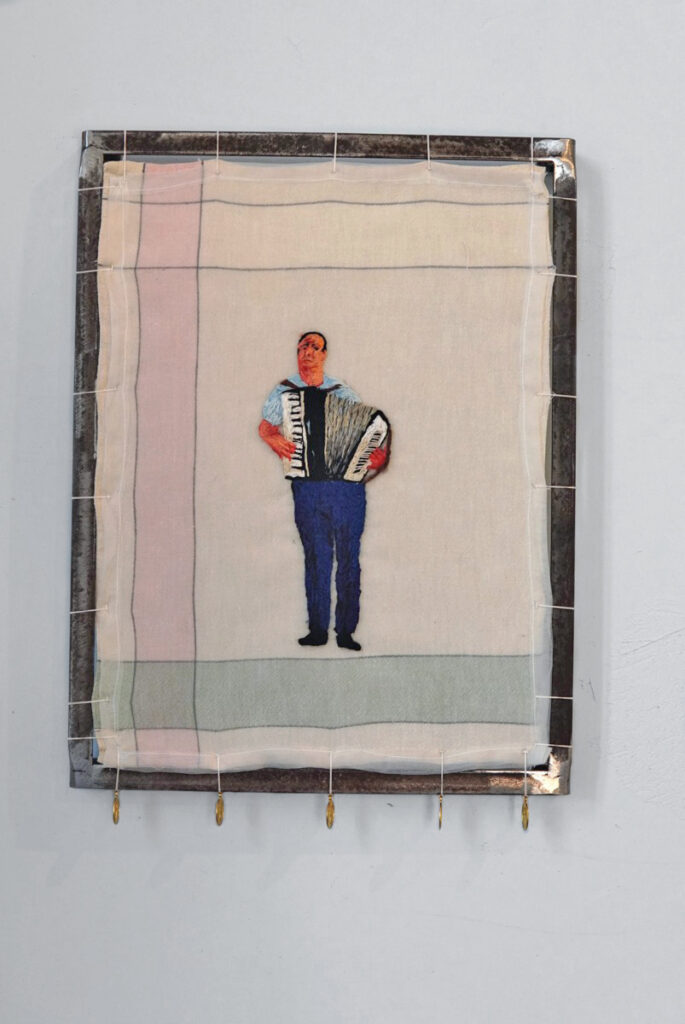
Fanari, Karditsa, Greece, 1940.
The bride walks to the church accompanied by an accordion player and a clarinetist, who together lead the wedding procession. Such rituals were central to maintaining communal traditions in rural areas, where music marked collective participation in marriage ceremonies. The “flouria”, gold coins worn across the bride’s chest symbolize her dowry.
In Greece, the dowry system traditionally consisted of household goods, land, money, and woven textiles, which women prepared for their daughters over many years, often beginning in early childhood. The size and quality of a woman’s dowry could significantly influence her marriage prospects, functioning as a social mechanism through which her value, status, and reputation were assessed. This system was officially abolished in Greece in 1982. Here, the bride wears the flouria as a demonstration of her “richness,” both metaphorical and material, now that she enters her new role.
This work is inspired by real individuals and photographic archival material depicting a typical traditional Greek wedding ceremony.